The New Delhi Declaration, adopted at the 18th BRICS Summit 2026 in India, marks a defining moment for the Global South. Hosted by Prime Minister Narendra Modi at Bharat Mandapam in New Delhi on September 12-13, 2026, the summit brought together leaders including Chinese President Xi Jinping, Russian President Vladimir Putin, Iranian President Masoud Pezeshkian, and other BRICS partners. Against the backdrop of geopolitical tensions, the Russia-Ukraine conflict, West Asia instability, and shifting global trade dynamics, the New Delhi Declaration outlines a clear path toward resilience, innovation, cooperation, and sustainability.
What is the New Delhi Declaration?
The New Delhi Declaration is the official outcome document of the BRICS Summit 2026. It reflects India’s chairmanship priorities and the collective aspirations of the expanded “Greater BRICS” grouping, which represents nearly 50% of the world’s population, around 40% of global GDP, and more than 25% of world trade. The declaration emphasizes inclusive global growth, multipolarity, and a rules-based international order free from double standards.

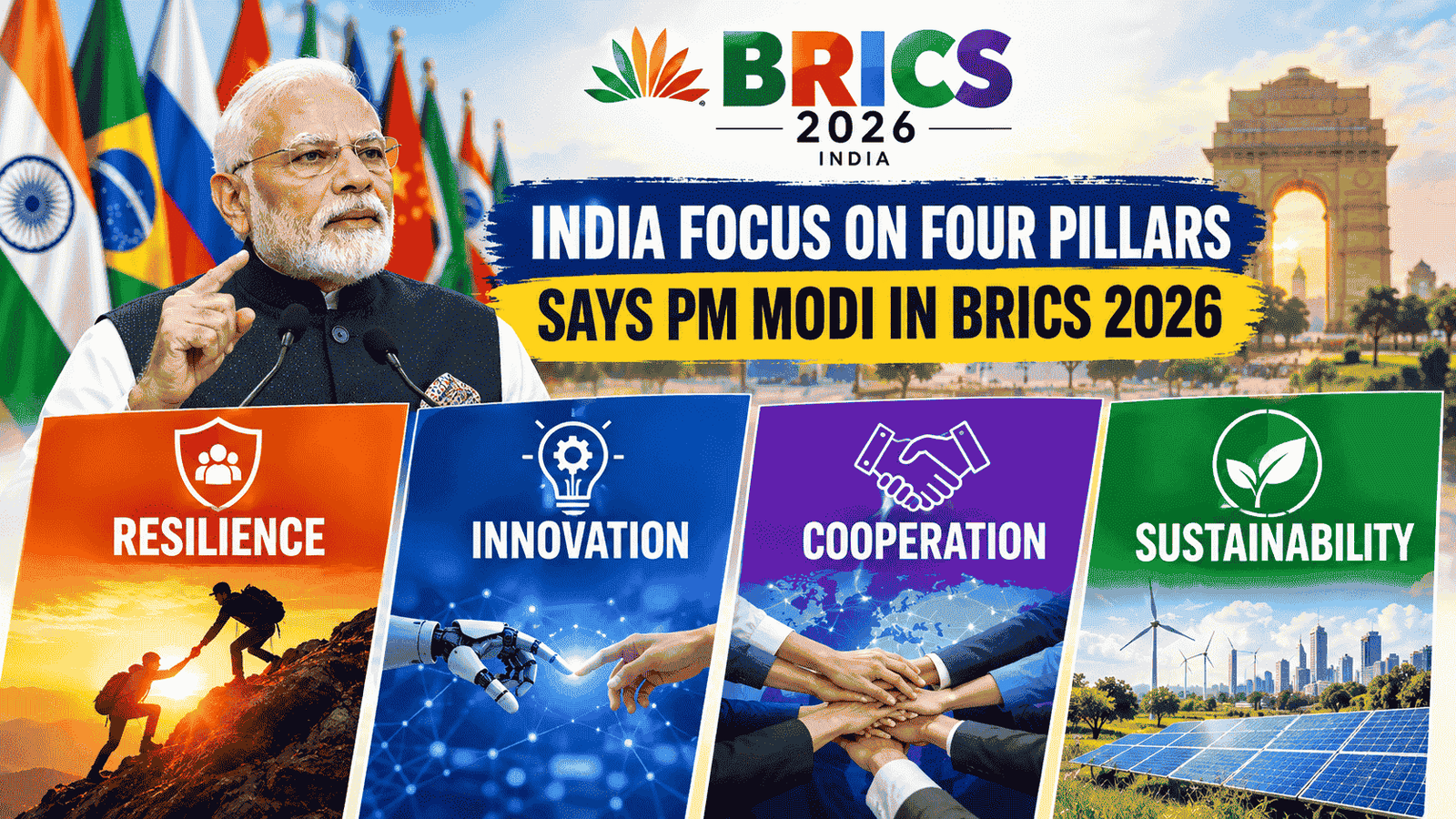
Prime Minister Narendra Modi, while addressing the concluding session, underlined that BRICS must rise through cooperation and inclusive growth for the sake of humanity. He highlighted India’s focus on four core pillars that form the foundation of the New Delhi Declaration:
- Resilience – Building economic and institutional strength to withstand global shocks
- Innovation – Advancing technology, including artificial intelligence, for shared benefit
- Cooperation – Strengthening partnerships across the Global South
- Sustainability – Promoting environmentally responsible and equitable development
Major Highlights of the New Delhi Declaration
- Opposition to Weaponisation of Technology and Critical MineralsA standout element of the New Delhi Declaration is the strong caution against the weaponisation of technology and critical minerals. PM Modi warned that such practices threaten shared progress and prosperity. The declaration calls for open, inclusive, and equitable access to technology and resources, ensuring that innovation serves development rather than division.
- Open-Source AI and Digital CooperationChinese President Xi Jinping proposed the creation of an “open-source AI zone” for BRICS countries. The New Delhi Declaration supports cooperation in large language models, AI development, and digital public infrastructure. This initiative aims to prevent technological monopolies and empower the Global South with accessible, collaborative AI tools.
- Strengthening Multipolarity and the Global SouthThe declaration positions BRICS as a stabilising force in a world undergoing profound changes. It reaffirms commitment to sovereign equality, non-interference, peaceful dispute resolution, and the equal application of international law. Leaders stressed that the Global South must play a greater role in shaping global governance.
- Economic Cooperation and Supply Chain StabilityThe New Delhi Declaration prioritises maintaining stable industrial and supply chains, cultivating integrated markets, upgrading traditional industries, and fostering emerging and future industries. It encourages innovation incubators and practical economic collaboration among Greater BRICS nations.
- Peace and Dialogue InitiativesOn the sidelines, both Prime Minister Narendra Modi and President Xi Jinping offered their good offices for peace talks on Ukraine. The Kremlin welcomed this readiness. While the declaration itself focuses on broader principles of peaceful resolution of conflicts, these diplomatic signals reinforce the summit’s constructive spirit.

Why the New Delhi Declaration Matters
The New Delhi Declaration comes at a critical juncture. With the United Nations Security Council widely viewed as paralysed and global power dynamics shifting, BRICS under India’s leadership has projected itself as a platform for practical cooperation rather than confrontation. The document balances ambition with pragmatism—advancing technology and trade while safeguarding sovereignty and sustainability.
By hosting the summit and shaping the New Delhi Declaration, India has reinforced its role as a bridge between major powers and the wider Global South. The emphasis on resilience, innovation, cooperation, and sustainability offers a people-centric alternative to fragmented global approaches.
Also Read This : BRICS Summit 2026 : Important Modi-Putin Meeting Begins in Delhi, Bilateral Talks Also Scheduled with Pezeshkian
The New Delhi Declaration sets the tone for BRICS engagement in the years ahead. As the grouping continues to expand its influence, the commitments made in New Delhi on open-source AI, critical minerals, inclusive growth, and multipolarity will be closely watched. For India, the successful hosting of the 2026 summit and the adoption of this landmark declaration strengthen its credentials as a responsible global stakeholder committed to a more balanced and equitable world order.
The message from Bharat Mandapam is clear: through unity, innovation, and shared purpose, BRICS can contribute meaningfully to global stability and prosperity. The New Delhi Declaration stands as a testament to that vision.
View this post on Instagram