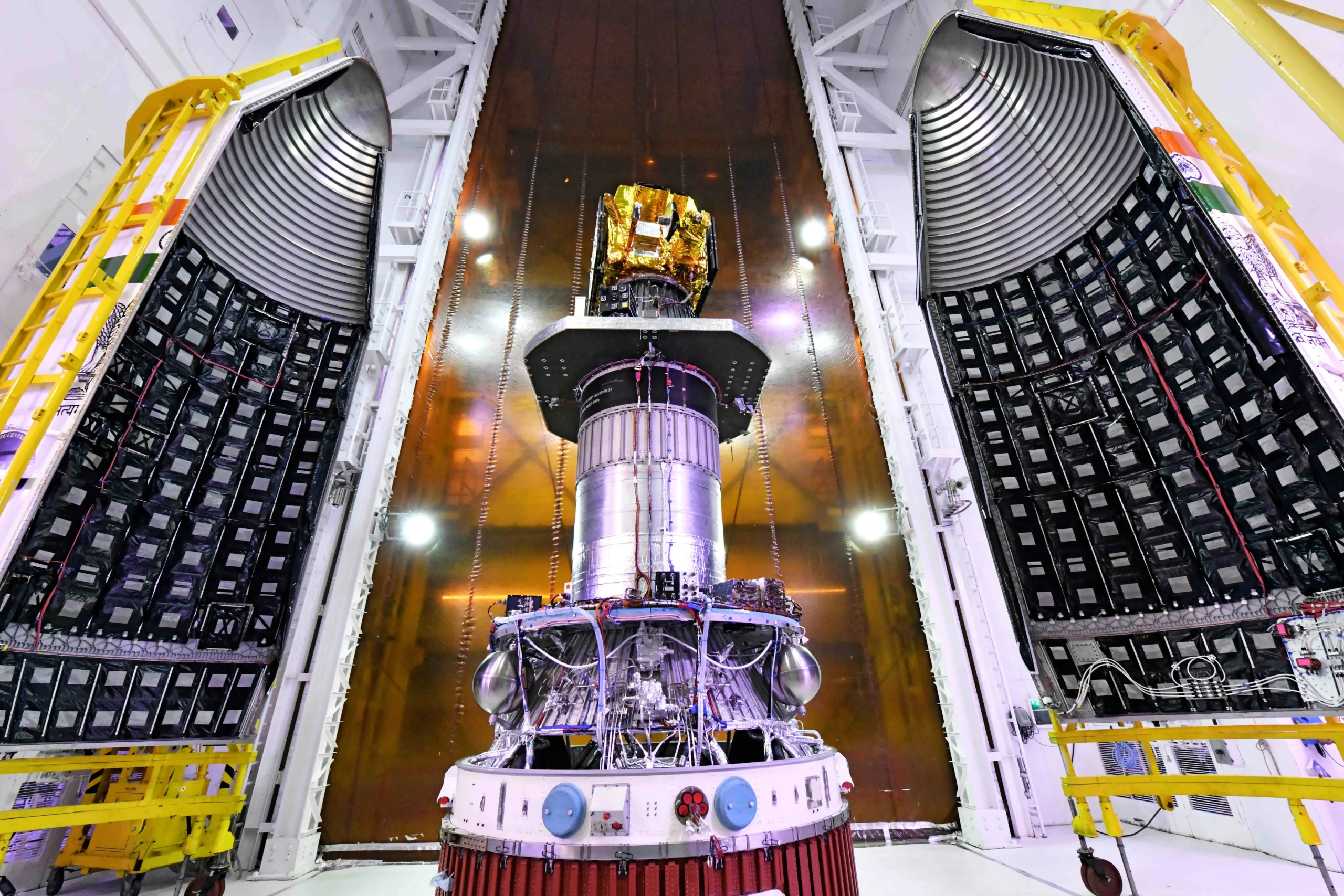
Anvesha Satellite : India’s space program encountered a significant setback on January 12, 2026, when the Indian Space Research Organisation (ISRO)’s PSLV-C62 mission failed during its third stage, resulting in the loss of the primary payload: the Defence Research and Development Organisation (DRDO)’s advanced hyperspectral Earth observation satellite, Anvesha (officially EOS-N1).
What Was Anvesha Satellite ?
Developed by DRDO’s Instruments Research & Development Establishment (IRDE), Anvesha was a sophisticated hyperspectral imaging satellite weighing around 400 kg. It was designed for deployment in a sun-synchronous orbit at approximately 505-512 km altitude.
Hyperspectral imaging stands out from traditional multispectral or optical satellites by capturing data in hundreds of narrow spectral bands across the electromagnetic spectrum. This technology enables the detection of unique material signatures, allowing the satellite to:

- Identify camouflaged military assets, track troop movements, and enhance border and maritime surveillance.
- Support civilian applications such as precision agriculture (detecting crop diseases and soil nutrients), environmental monitoring, mineral exploration, urban planning, and disaster response.
Anvesha represented a major advancement in India’s indigenous remote sensing and intelligence, surveillance, and reconnaissance (ISR) capabilities, often referred to as a strategic “eye in the sky.”
The PSLV-C62 Mission Overview
Launched from the First Launch Pad at Satish Dhawan Space Centre in Sriharikota at 10:18 AM IST, PSLV-C62 was ISRO’s first mission of 2026 and the 64th flight of the reliable Polar Satellite Launch Vehicle (PSLV-DL variant).
The mission carried:
- Primary Payload: Anvesha (EOS-N1)
- 15 Co-Passenger Satellites: Innovative payloads from Indian startups (e.g., AayulSAT for on-orbit refuelling demonstration by OrbitAID Aerospace), universities, and international partners (including Nepal, Spain, and others). Notable among them was the Spanish KID re-entry capsule demonstrator.
The liftoff and initial stages proceeded nominally, with successful separation of the first and second stages.

The Mission Failure
During the third stage (PS3) burn, the vehicle experienced a critical anomaly, described by ISRO as a “disturbance in roll rates” leading to trajectory deviation. The rocket failed to achieve the necessary orbital velocity, preventing satellite deployment.
ISRO Chairman V. Narayanan confirmed the issue shortly after launch, stating that data analysis was underway. All satellites, including Anvesha, are presumed lost, likely re-entering and burning up in the atmosphere.
One minor positive note: The Spanish KID re-entry capsule reportedly separated successfully and transmitted data briefly before being lost.
This failure marks the second consecutive PSLV setback due to third-stage issues, following PSLV-C61 in May 2025, which also involved pressure anomalies in the same stage.
Current Status and Ongoing Investigation
As of January 17, 2026, ISRO has initiated a detailed failure analysis, including review of telemetry data, hardware examination, and potential issues like flex nozzle failures, propellant defects, or casing problems. No official root cause has been announced yet, and the agency has formed a Failure Analysis Committee to investigate.

The loss delays India’s hyperspectral capabilities, impacting both defence readiness and civilian remote sensing applications. It also affects the private space sector, as several startup payloads were onboard.
Also Read This : WPL Points Table 2026 : Latest Standings After RCB’s Thrilling Win Over Gujarat Giants
Anvesha Satellite : Despite this challenge, ISRO’s PSLV remains one of the world’s most reliable launch vehicles, with a strong history of successes powering missions like Chandrayaan-1 and Mangalyaan. Setbacks are inherent in space exploration, and past failures have often led to stronger systems.
The investigation’s findings will be crucial for restoring confidence and resuming the ambitious 2026 launch schedule, including preparations for Gaganyaan and other missions.