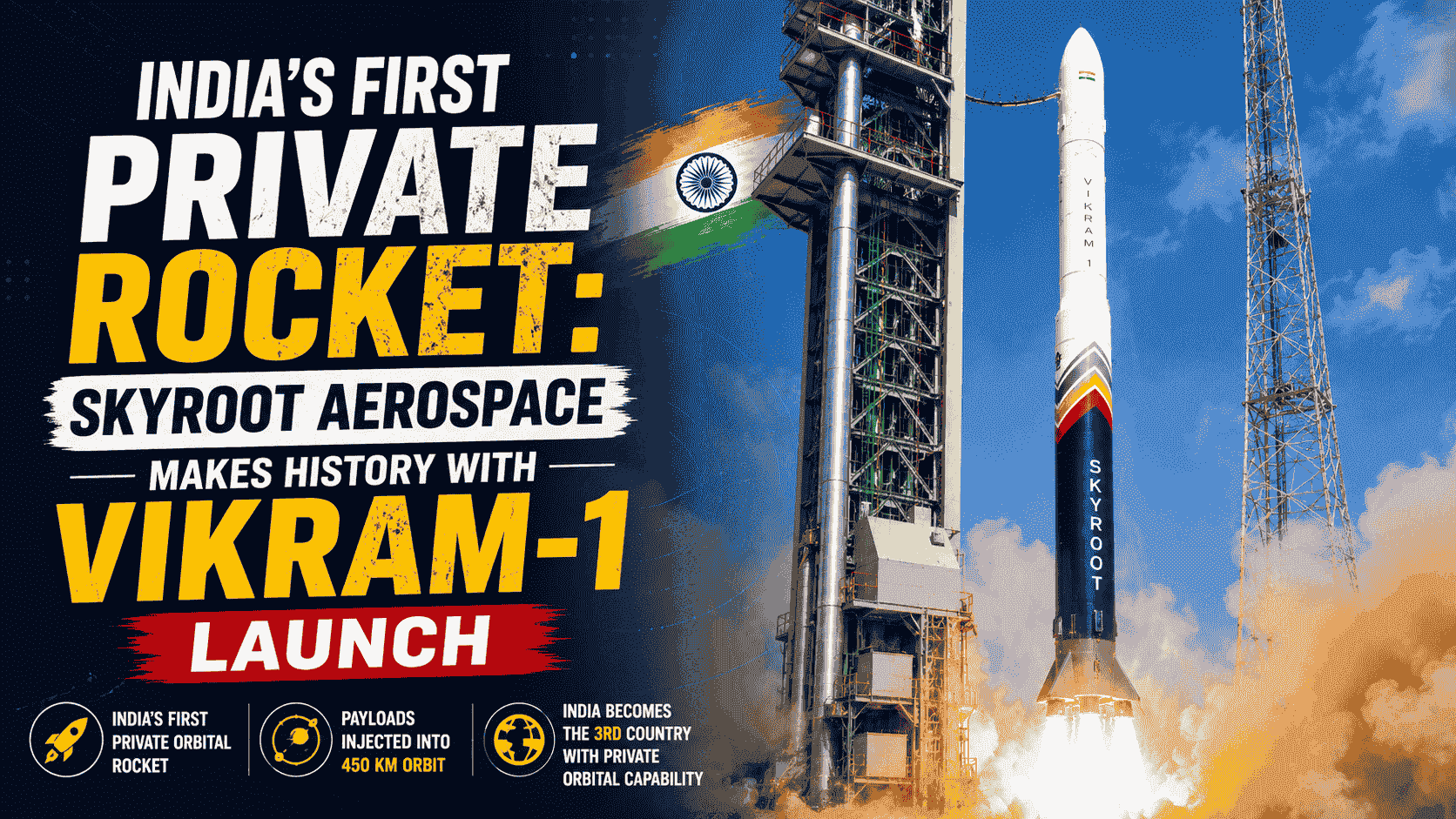
In a landmark achievement for India’s space industry, Skyroot Aerospace has successfully launched India’s first private rocket into orbit. Named Vikram-1, this mission — codenamed “Mission Aagaman” — marks a new era in Indian space exploration, where private companies are now capable of developing and launching orbital-class rockets.
On July 18, 2026, the 20–24 metre tall Vikram-1 rocket lifted off from the Satish Dhawan Space Centre in Sriharikota, making India one of the few nations with proven private orbital launch capability.
What Makes This Launch Historic?
The successful flight of India’s first private rocket is more than just a technical milestone. It represents the growing strength of India’s private space ecosystem and the fruition of government policies that opened up the sector to startups.

Skyroot Aerospace, a Hyderabad-based startup founded by former ISRO scientists, designed and built the Vikram-1 entirely in India. The rocket features an all-carbon composite structure, advanced solid rocket motors, and 3D-printed components — showcasing world-class indigenous technology.
Mission Aagaman : Key Highlights
- Rocket: Vikram-1 (four-stage orbital launch vehicle)
- Payload Capacity: Up to 350 kg to Low Earth Orbit
- Orbit Targeted: Approximately 450 km altitude at 60° inclination
- Payloads: Included satellites and technology demonstrators from Indian startups (Grahaa Space, Cosmoserve) and Germany’s Dcubed, along with Skyroot’s own SCOPE satellite.
The primary objective of this maiden flight was to collect real-time flight data on propulsion, stage separation, guidance, navigation, and control systems. This data will be crucial for refining future commercial launches.
Significance for India
The launch of India’s first private rocket strengthens the country’s position in the global small satellite launch market. With increasing demand for dedicated and responsive launches, Skyroot aims to offer cost-effective and rapid access to space for both domestic and international customers.
Prime Minister Narendra Modi congratulated the Skyroot team, stating that this achievement will inspire countless young Indians to dream bigger in science and innovation.
View this post on Instagram
India’s First Private Rocket : The Road Ahead
This success is just the beginning. Skyroot has already announced plans for an upgraded variant, Vikram-1U, with higher payload capacity. With more test flights planned, the company is gearing up for regular commercial operations in the coming years.
The successful debut of India’s first private rocket not only boosts national pride but also signals to the world that India is serious about becoming a major player in the global space economy, projected to reach $600 billion in the near future.
Also Read This : West Asia Tensions Put Pressure on Crude Prices; Mixed Sentiment in Asian Markets
The launch of Vikram-1 by Skyroot Aerospace will be remembered as the moment when India’s private space sector truly arrived. As India’s first private rocket soars into the skies, it carries with it the dreams and ambitions of a new generation of Indian space entrepreneurs.