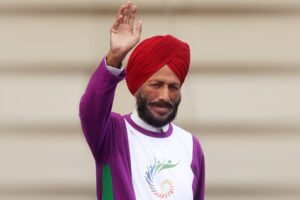
Childhood and Misfortune
A Sikh Rathore Rajput family was the birthplace of Milkha Singh. Despite a modest upbringing and limited resources, he lived a peaceful life before India’s 1947 Partition. His family was severely affected by the violence and bloodshed of the partition; he saw his parents, two sisters, and a brother brutally murdered. When Milkha fled to India as a teenager, he was devastated and alone.
To escape the violence and intercommunal riots, he travelled to Delhi by train.He fought to survive in a refugee camp at Old Delhi Railway Station with family members. During this desperate time in his life, he even contemplated committing crimes, but destiny had other ideas.
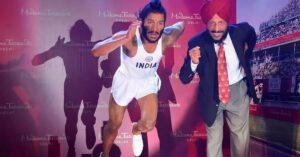
Enlisting in the Army and Learning About Sports
The moment Milkha Singh enlisted in the Indian Army was a turning point in his life. He made several attempts before being chosen on his fourth try. His athletic abilities were discovered while he was assigned to the Electrical Mechanical Engineering (EME) unit in Secunderabad.
The army gave him the opportunity, discipline, and structure he needed to train. His ascent as an athlete was fuelled by his dedication, innate talent, and will to overcome his past.
Singh started running cross-country and soon rose to the top of his unit’s running rankings. His career took off after he won his first significant race, a 400-meter race at the Services meet.
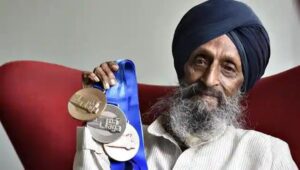
Breakthrough on a National and International Level
Milkha Singh made his debut for his country at the 1956 Summer Olympics in Melbourne, but he did not take home a medal. But it was a teaching moment that motivated him to work out even more. He adopted strict training regimens after studying the strategies of accomplished athletes.
The actual breakthrough occurred in 1958. He became the first Indian athlete to win an individual gold medal at the Commonwealth Games in Cardiff, where he won the gold medal in the 440 yards, or roughly 400 meters. He also took home gold in the 200- and 400-meter events at the Tokyo Asian Games that same year.
He became a national hero as a result of these triumphs, and the nation began to celebrate his accomplishments.
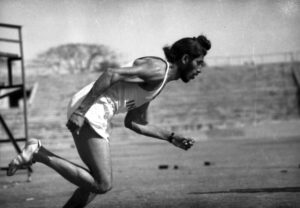
The Legendary Rome Olympics of 1960
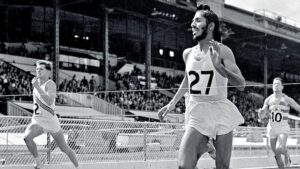
The 1960 Summer Olympics in Rome were arguably Milkha Singh’s most pivotal event. He competed in the 400 meters, where he was among the front-runners for a medal. Milkha ran the race of his life, missing the bronze by just 0.1 seconds and finishing fourth in a race full of tension and exceptional competitors.
This performance was praised worldwide even though it did not result in a medal. His final time of 45.73 seconds was a national record for 40 years, and he broke the Olympic record in the heats and semi-finals. His near-miss turned into a legend and greatly aided in his rise to prominence.
After this race, Milkha Singh’s performance against Pakistani sprinter Abdul Khaliq in Lahore impressed Pakistan’s General Ayub Khan, who gave him the nickname “The Flying Sikh,” which he would always use.

Subsequent Career and Input
In international competitions, Milkha Singh kept up her strong performance. At the 1962 Asian Games, he took home two more gold medals in the 400-meter and 4×400-meter relays. But as he grew older and sustained injuries, he eventually gave up competitive sports.



 समाचार
 समाचार