

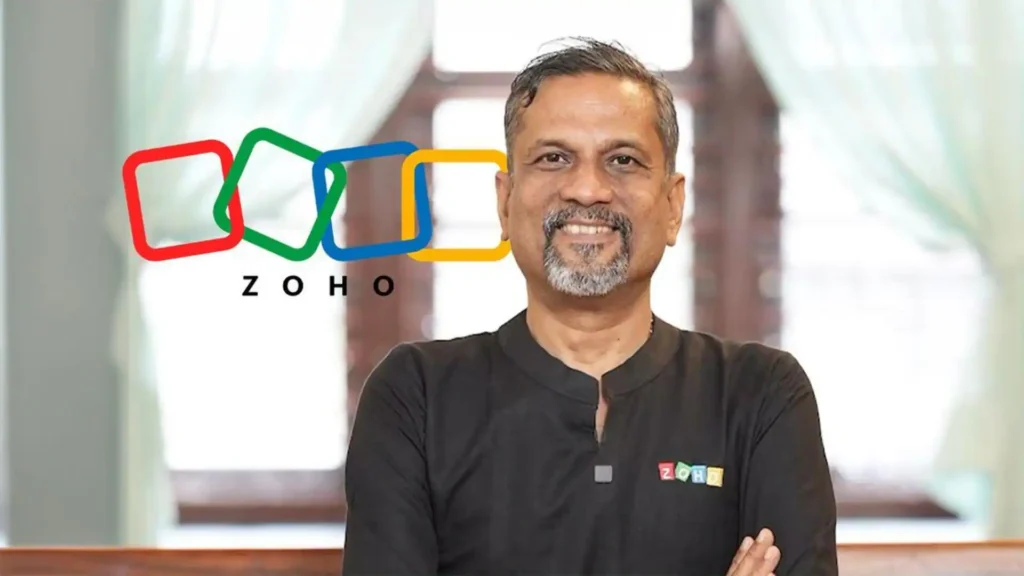
Sridhar Vembu : In the fast-paced world of tech giants dominated by flashy valuations and Silicon Valley hype, Sridhar Vembu stands out as a beacon of understated brilliance. As the founder, chief scientist, and until recently, CEO of Zoho Corporation, Vembu has quietly built a multinational software powerhouse valued at billions without chasing IPO glory or venture capital fanfare. Born in 1968 in the culturally rich city of Thanjavur, Tamil Nadu, into a middle-class family, Vembu’s journey is a testament to resilience, innovation, and an unyielding commitment to “Made in India” ethos. Today, on October 7, 2025, as Zoho’s latest venture Arattai continues its meteoric rise with fresh endorsements from industry leaders, Vembu’s story feels more relevant than ever – a reminder that true disruption often comes from the roots, not the headlines.

Roots in Rural India: A Foundation of Simplicity
Vembu’s early life was far from the glamour of urban tech hubs. Raised in a modest household, he credits his mother’s influence for instilling values of hard work and humility. Pursuing a B.Tech in Electrical Engineering from the prestigious Indian Institute of Technology (IIT) Madras, Sridhar Vembu honed his technical acumen amid India’s burgeoning tech scene of the late 1980s. After a brief stint in the U.S., working on network management software, he returned to India with a vision: to create world-class technology that empowers local talent and solves global problems.
In 1996, Vembu co-founded AdventNet (later rebranded as Zoho Corporation) in Chennai with his siblings, Sridharan and Radha. Starting with just a handful of employees and bootstrapped funds, the company focused on network management tools – a niche that would evolve into a suite of over 50 cloud-based applications for businesses worldwide. What began as a survival play in a competitive market has grown into a $1 billion+ revenue behemoth, serving millions of users across 150+ countries without a single dollar of external funding. Vembu and his siblings retain majority ownership, a deliberate choice to preserve independence.
Building Zoho: Innovation Without the Noise
Zoho’s secret sauce? Relentless R&D and a disdain for short-term trends. Under Vembu’s leadership, the company pioneered affordable, privacy-focused alternatives to giants like Salesforce, Microsoft, and Google Workspace. Tools like Zoho CRM and Zoho Mail have democratized enterprise software for small businesses, emphasizing data sovereignty and open-source ethos. “Proudly Made in India, Made for the World,” Vembu recently affirmed in a post defending Zoho’s data hosting practices, underscoring the company’s commitment to Indian infrastructure.

Vembu’s philosophy extends beyond products. He’s a vocal advocate for rural innovation, establishing Zoho’s development centers in places like Tenkasi, a small town in Tamil Nadu where he now resides. Living in a modest village home far from urban luxuries, Vembu embodies “Dharmic Capitalism” – profit with purpose, blending business success with social upliftment. In a recent interview, he explained why Zoho shuns public markets: “Projects like Arattai wouldn’t exist if we had gone public,” highlighting how staying private allows bold, long-term bets on innovation over shareholder pressures.
| Milestone | Year | Key Achievement |
| Founding | 1996 | Launched AdventNet for network management software. |
| Rebranding | 2005 | Became Zoho Corporation, expanding into cloud apps. |
| Global Scale | 2015 | Reached 25 million users; established rural dev centers. |
| Billion-Dollar Club | 2022 | Hit $600M+ revenue; focused on AI and privacy tools. |
| Leadership Shift | 2025 | Stepped down as CEO to focus on R&D and mentorship. |
Sridhar Vembu and the Arattai Phenomenon
This year marks a pivotal shift for Sridhar Vembu. In January 2025, he transitioned from CEO to chief scientist, handing the operational reins to trusted lieutenants while diving deeper into research. His focus? Accelerating Zoho’s engineering depth, as evidenced by the launch of Arattai – a privacy-first messaging app billed as India’s answer to WhatsApp.
Debuting in late September 2025, Arattai skyrocketed from 3,000 to 350,000 daily sign-ups, with a 100x surge in traffic within three days and reaching 7.5 million overall downloads by early October. Topping app charts and now boasting an official Android TV app – a unique feature absent in rivals like WhatsApp, Signal, or Telegram – it promises crisp calls, multilingual support for India’s linguistic diversity, and end-to-end encryption (with text E2EE on the roadmap). Vembu, ever the engineer, shared in a team huddle: “Being a dedicated engineer is like being a Rishi… Allow neither praise nor criticism nor fame to distract you, resolutely stay the course.” He emphasized the app’s deceptive simplicity, built on 20 years of homegrown tech frameworks for real-time messaging and distributed systems.
Yet, challenges abound. Amid viral hype, users flagged lags in message delivery and contact sync issues, prompting Vembu’s hands-on fixes: “We are addressing these bottlenecks one by one.” Privacy remains paramount – no ads, no data mining – a stark contrast to global rivals. In a candid exchange with the Republic’s Arnab Goswami, Vembu urged national self-belief: “We need to believe in ourselves as a nation and people.”