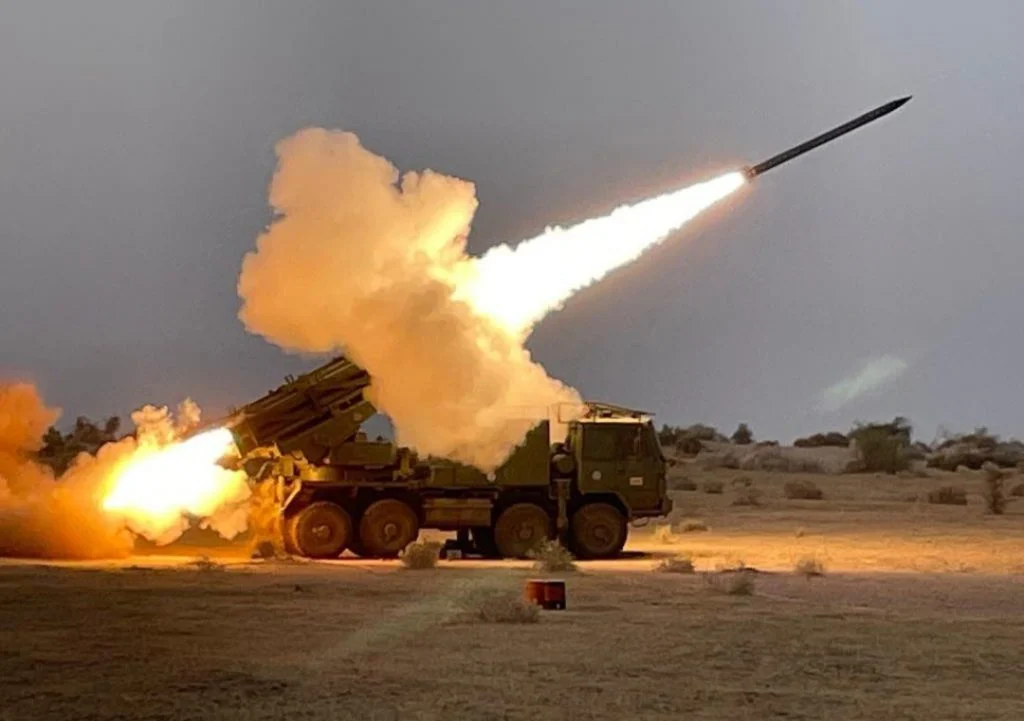
The Pinaka multi-barrel rocket launcher system stands as one of the Indian Army’s most significant indigenous artillery assets. Developed by the Defence Research and Development Organisation (DRDO), Pinaka delivers rapid, high-volume firepower and has evolved from a concept in the 1980s into a modern, versatile rocket artillery platform. Named after Lord Shiva’s legendary bow, the system reflects both cultural symbolism and technological ambition. Mounted on a robust truck chassis, a single Pinaka launcher can unleash a devastating salvo of rockets in a short span, making it a critical force multiplier on the modern battlefield.
Origins and Development Journey
Development of Pinaka began in the early 1980s when the need for a long-range indigenous artillery system became clear. In 1981, the Ministry of Defence approved a project to create such a capability. By 1983, the Indian Army had formalised its qualitative requirements. The Armament Research and Development Establishment (ARDE) was designated the lead laboratory, coordinating efforts across multiple DRDO laboratories.
The programme faced the typical challenges of complex weapons development—propulsion, warhead design, launcher mobility, and fire-control systems. Extensive trials refined the system over the years. The result was a multi-barrel rocket launcher capable of saturating targets with high-explosive rockets at ranges far exceeding conventional tube artillery of that era.

Baptism by Fire: Kargil and Early Induction
Pinaka’s operational debut came during the 1999 Kargil conflict. A detachment of two launchers from the 121 Rocket Regiment was deployed in the high-altitude theatre. Its ability to deliver concentrated fire on enemy positions in difficult terrain proved valuable and helped establish the system’s credibility within the Army’s rocket artillery inventory.
Following this experience, the first Pinaka regiment was raised in February 2000. By 2010, two regiments were fully operational. The Army subsequently planned progressive expansion to replace older rocket systems with the modern indigenous platform.
Pinaka : Capabilities and Variants
A standard Pinaka launcher carries 12 high-explosive rockets and can fire a complete salvo in a very short time. This “shoot-and-scoot” capability enhances survivability against counter-battery fire.
Two key versions highlight the system’s growth:
- The Pinaka Mark-I Enhanced variant offers a maximum range of approximately 45 km.
- A longer-range guided rocket version extends the reach to around 120 km, adding precision-strike options.
These improvements allow Pinaka to engage a wider set of targets, from troop concentrations and logistics nodes to fortified positions, while reducing collateral risk through better accuracy in the guided version.
Production Scale-Up and Force Expansion
Recognising the need for higher availability, the government in April 2013 sanctioned ₹1,388.80 crore to expand rocket production capacity from 1,000 to 5,000 units per year. The capacity enhancement was completed by 2014, ensuring steady supply for ongoing induction and training.
Force structure has expanded steadily. In March 2024, plans emerged to raise two additional Pinaka regiments for deployment near the Line of Actual Control. By June 2025 these regiments had been formed, with training and equipment induction continuing.

As of 15 March 2026, the Indian Army had inducted and made operational seven Pinaka regiments. An eighth regiment had been raised and had received more than half of its equipment. Plans call for the ninth and tenth regiments to join the order of battle in 2027. This measured expansion reflects both confidence in the system and a deliberate approach to building trained crews and support infrastructure.
Future Role in an Integrated Rocket Force
Looking ahead, Pinaka is expected to form part of a proposed Integrated Rocket Force that would combine complementary systems such as Pralay, Nirbhay, and BrahMos. In such a structure, Pinaka would provide the high-volume area-fire element, while longer-range and precision-guided missiles handle specialised missions. This integration would give the Army a layered, flexible rocket and missile arsenal capable of addressing a spectrum of threats.
Strategic Significance
Pinaka embodies the success of India’s defence indigenisation drive. It reduces dependence on foreign suppliers, creates a domestic production base, and delivers a system tailored to the Army’s operational requirements across plains, deserts, and high-altitude sectors. Continuous upgrades in range, accuracy, and production capacity ensure the platform remains relevant against evolving threats.
Also Read This : Trump son linked company strikes drone deal with Pakistan Army : agreement reached even on initial order
From its conceptual roots in the 1980s, through combat validation in Kargil, to its growing presence as a multi-regiment force in 2026, Pinaka has matured into a cornerstone of Indian rocket artillery. As the ninth and tenth regiments prepare for induction and the system finds its place in broader force structures, Pinaka continues to strengthen India’s conventional deterrence and operational flexibility.
View this post on Instagram