
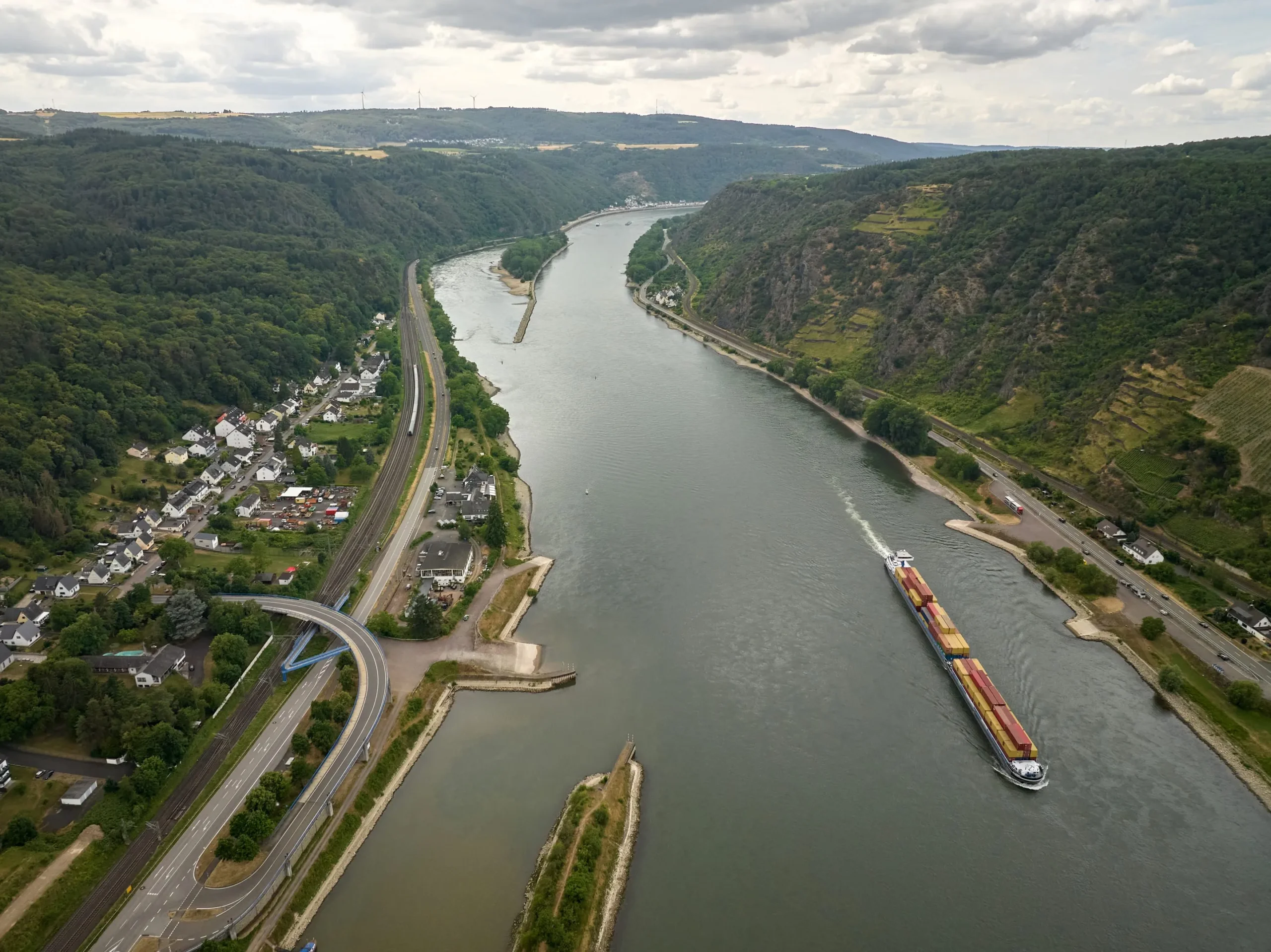
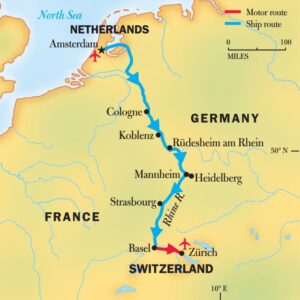
The Rhine River, a significant geographical heritage of Europe, stretches approximately 765 miles (1,230 kilometers). Originating from the Swiss Alps, it flows into the North Sea in the Netherlands. Passing through six countries—Switzerland, Liechtenstein, Austria, Germany, France, and the Netherlands—it serves as a lifeline for trade, culture, and history. The river originates in the Graubünden region of Switzerland from two primary streams—the Anterior Rhine (Vorderrhein) and the Posterior Rhine (Hinterrhein)—which merge near Reichenau. It then flows through Lake Constance, cascades over the Rhine Falls near Schaffhausen (Europe’s largest waterfall), and continues northward, shaping various geographical borders and landscapes along its course.
Key Sections of the Rhine River
The Rhine River is divided into four main segments:
- High Rhine: From Lake Constance to Basel, known for its steep gradient and rapid flow.
- Upper Rhine: From Basel to Bingen, a broader stretch forming the border between France and Germany.
- Middle Rhine: From Bingen to Bonn, characterized by valleys, castles, and UNESCO World Heritage sites.
- Lower Rhine: From Bonn to the delta, where the river widens and slows down.
In the Netherlands, the Rhine splits into multiple branches, forming a vast delta and merging with distributaries like the Waal and IJssel before reaching the sea.
Historical Significance
For thousands of years, the Rhine River has shaped civilizations. It served as the northern boundary of the Roman Empire, with fortresses established in cities like Mainz. During the Middle Ages, it became a major trade route, and the Industrial Revolution transformed it into a crucial transportation hub. Today, about 20% of the world’s chemical industry is located along its banks, contributing to the economic prosperity of cities like Basel, Strasbourg, Cologne, and Rotterdam. The Middle Rhine, with its vineyard-covered hills and famous legends—such as the Lorelei siren—remains a cultural treasure.
Environmental Updates (as of February 25, 2025)
Climate change has become a major challenge for the Rhine River. In 2022, water levels at the crucial Kaub checkpoint dropped to just 32 centimeters, disrupting the transport of coal, oil, and chemicals (with 310 million tonnes transported annually in the Dutch section). According to reports from the International Commission for the Hydrology of the Rhine Basin, if these trends persist, some parts of the river could dry up within decades. Meanwhile, restoration projects along the Austria-Switzerland border are working to rehabilitate floodplains, enhancing biodiversity and flood resilience. These efforts aim to counterbalance past engineering modifications, such as the 19th-century straightening of the river by Johann Gottfried Tulla, which improved navigation but harmed natural habitats.

Economic and Cultural Role
The Rhine remains a powerful economic force, supporting industries and renewable energy projects, such as Germany’s hydrogen network in North Rhine-Westphalia. Culturally, it attracts millions of tourists, particularly to the Rhine Valley, and plays a significant role in events like the 2025 European Football Championship in Cologne. Environmental efforts, such as the Rhine Action Programme, initiated after World War II, have led to a revival of fish populations, especially salmon, though achieving ecological balance remains an ongoing challenge.
Also Read This: What is USAID? History, Mission, and Challenges in 2025
Future Outlook
The future of the Rhine River depends on balancing its dual role—as a heavily utilized waterway and as a fragile natural ecosystem threatened by climate change. As of early 2025, its story is one of resilience, adaptation, and the ongoing struggle between human ambition and nature’s limitations.