NISAR Mission
Meaning and Introduction of NISAR
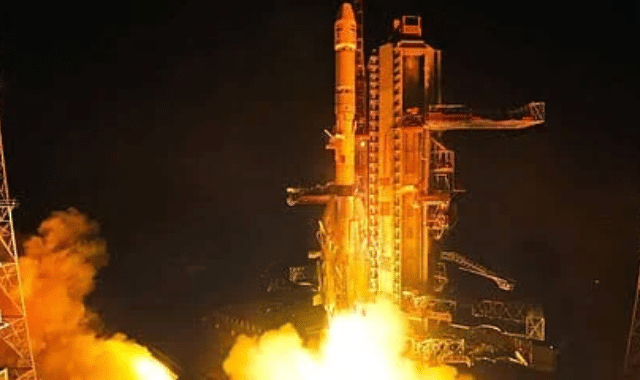
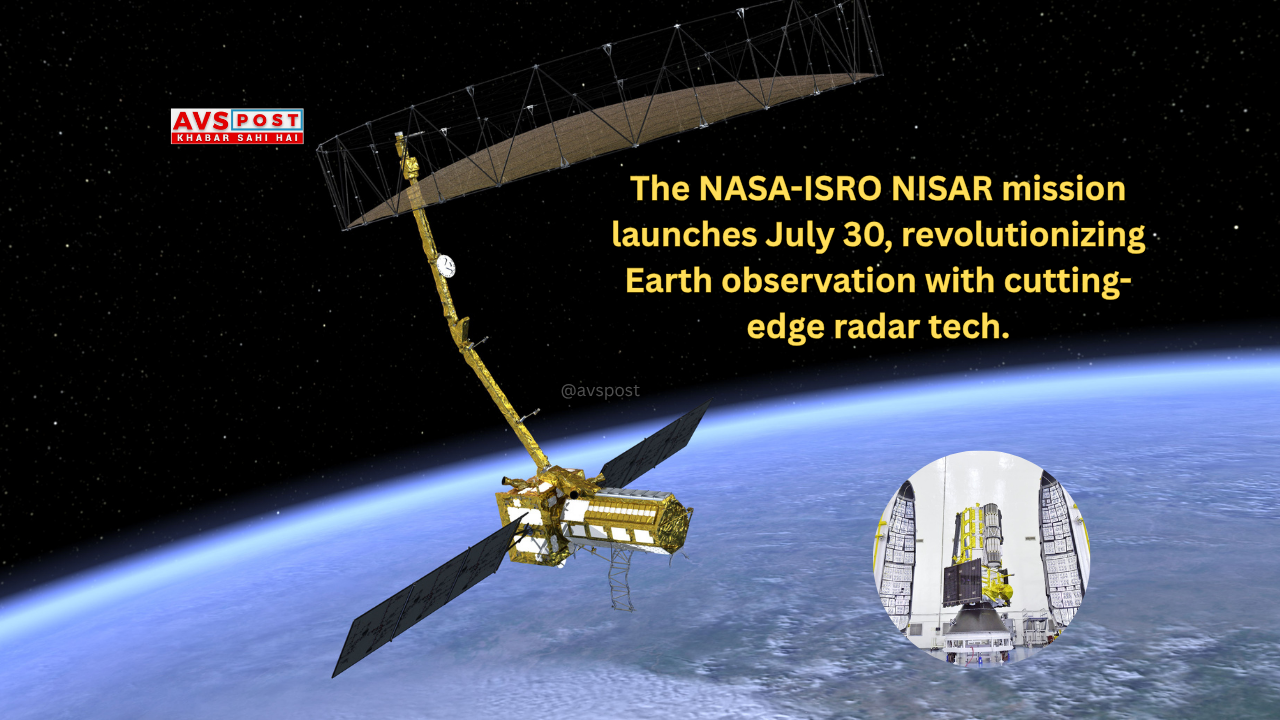
NISAR stands for NASA-ISRO Synthetic Aperture Radar. It is a joint satellite mission between NASA (National Aeronautics and Space Administration) and ISRO (Indian Space Research Organisation), designed for Earth observation. The NISAR mission is set to launch on July 30, 2025, from the Satish Dhawan Space Centre in Sriharikota using the GSLV-F16 rocket. With an estimated cost of approximately 1.5 billion USD, it is the world’s most expensive Earth observation satellite.
Objectives of the NISAR Mission
The primary objective of NISAR is to monitor changes in Earth’s surface and ice masses.The satellite will survey almost the entire Earth’s surface every 12 days, delivering vital data in the following key areas:
- Study of Natural Disasters: Monitoring hazards such as earthquakes, tsunamis, volcanic eruptions, and landslides.
- Climate Change: Monitoring shifts in ice sheets, glaciers, and sea ice.
- Agriculture and Environment: Monitoring soil moisture, vegetation biomass, and crop cycles.
- Resource Management: Managing groundwater levels and natural resources.
Technical Specifications
NISAR is the world’s first satellite to use dual-frequency radar (L-band and S-band). Its key features include:
- L-band Radar: Developed by NASA, it uses long wavelengths (24 cm) to penetrate dense forests, ice, and soil. It is useful for landscape topography and polar region monitoring.
- S-band Radar: Developed by ISRO, it monitors surface changes with high resolution and is effective in measuring properties like soil moisture.
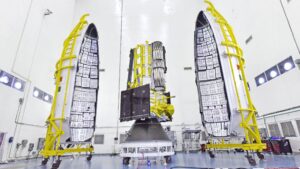
- Radar Antenna: A 12-meter deployable mesh antenna that sends and receives microwave signals from Earth’s surface.
- Orbit: The satellite will operate in a Sun-synchronous orbit at an altitude of 747 km, ensuring consistent lighting conditions.
Mission Cost and Collaboration
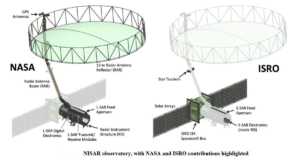
- Total Cost: Approximately 1.5 billion USD. ISRO’s contribution is around 788 crore INR (93 million USD), while NASA’s contribution is 1.118 billion USD.
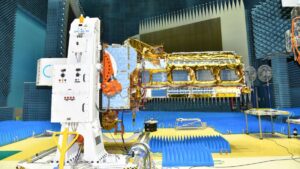
- Collaboration: This is the first large-scale collaboration between NASA and ISRO. NASA developed the L-band radar, and ISRO developed the S-band radar. The satellite’s integration and testing were conducted at ISRO’s facility in Bengaluru.
Launch and Preparations
- Launch Date: July 30, 2025, at 5:40 PM (IST).
- Launch Site: Satish Dhawan Space Centre, Sriharikota, India.
- Launch Vehicle: GSLV Mark II.
- Preparations: The satellite was transported from California to Bengaluru in October 2024 via NASA’s C-130 cargo aircraft. All preliminary tests were completed by January 2025.
Challenges and Delays
Originally scheduled for launch in March 2024, the mission was postponed due to technical reasons. The reflector was likely to face high temperatures during flight, so it was sent back to the manufacturer in California for a reflective coating.
Significance and Impact
- Scientific Impact: NISAR will detect changes in Earth’s surface at the centimeter level, aiding in the prediction of earthquakes and volcanic activities.
- Global Benefits: Its data will be used for disaster management, environmental monitoring, and resource management. The data will be openly available, benefiting the global scientific community and policymakers.
- India-US Collaboration: This mission represents a major milestone in space cooperation between the two countries, laying the foundation for future joint ventures.
Also Read This : The Ultimate Guide to Using Perplexity AI for High-Quality Blogging
The NISAR mission is set to usher in a new era in Earth observation technology. It is not only a symbol of technical collaboration between India and the US but will also play a crucial role in addressing climate change, earthquakes, floods, and other natural disasters. Its proposed launch on July 30, 2025, will be a historic and significant moment for scientists and the global community.