

Artificial intelligence: It is refers to the simulation of human intelligence in machines that are programmed to think, learn, and problem-solve. It allows machines to perform tasks that typically require human intelligence, such as understanding natural language, recognizing patterns, and making decisions. It is creating systems that can analyze data, learn from it, and then use that knowledge to perform tasks on their own. The most common examples of AI we interact with daily include virtual assistants like Siri and Alexa, recommendation engines on Netflix or Amazon, and even self-driving cars.
What are different types of Artificial intelligence?
Some different types of AI are as follows:
- Narrow AI (Weak AI) for examples: Virtual assistants like Siri, Google Assistant, Alexa and recommendation systems on platforms like Netflix or Amazon. It also comes in Self-driving cars and image recognition software.
- General AI (Strong AI) for example: AI researchers.
- Super intelligent AI, While still hypothetical, some experts predict that Super intelligent AI could eventually be developed.
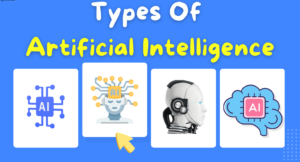
What are different types of Artificial intelligence?
How does Artificial intelligence work?
AI works in the following ways:
AI works by processing large amounts of data using algorithms to identify patterns and make decisions. It starts by collecting and cleaning data, then uses machine learning models to learn from this data. Its systems continuously improve over time through feedback, becoming more accurate and efficient at performing tasks. Its key technologies are machine learning, natural language processing, and computer vision enables AI to handle everything from language translation to facial recognition, with the ability to adapt and learn from new information.
What are the benefits and importance of AI?
Some of its benefits and importance of Artificial Intelligence are:
- It has an Increased Efficiency and Automation, AI automates repetitive tasks, reducing time and effort for humans, leading to faster and more efficient operations.
- It has improved Decision-Making by AI uses data to make accurate predictions and decisions, reducing human error and enhancing business outcomes.
- It has Personalized Solutions like healthcare, AI helps personalize treatments, predict patient outcomes, and improve diagnostic accuracy.
- It is Cost Reduction by automating processes and increasing productivity, AI can reduce operational costs for businesses.
- It is innovation and problem solving skills like AI fosters innovation by solving complex problems in fields like finance, education, and engineering.

What are the benefits and importance of AI? - It enhances Productivity as AI frees up humans from routine tasks, allowing them to focus on creative and strategic work.
- It has Driving Technological Advancements like AI powers emerging technologies like self-driving cars, smart homes, and virtual assistants, shaping the future of industries.
- It has Global Impact as AI has the potential to address major challenges in areas such as climate change, healthcare, and resource management.
- It has 24/7 Availability as AI systems can operate around the clock without fatigue, providing continuous support and service.
- It has Scalability as AI can scale solutions efficiently, handling large amounts of data and processes that would be impossible for humans alone.
What are the challenge and difficulties of Artificial intelligence?
Some of its challenges and difficulties are:
- It has Data Privacy and Security issue as AI systems require vast amounts of data, raising concerns about how personal information is collected, stored, and used, making privacy protection a critical issue.
- It is Bias and Discrimination problem as AI systems can inherit biases present in the data they’re trained on, leading to unfair decisions or reinforcing societal inequalities.
- It creates Job Displacement as AI automates tasks traditionally performed by humans, there are concerns about job loss and the need for workers to reskill and adapt to new roles.
- It has Lack of Transparency Many AI systems, especially deep learning models, operate in a “black box” manner, where it’s difficult to understand how decisions are made, leading to accountability and trust issues.
- It has a High Costs of Development issues like developing advanced AI systems requires significant resources, both in terms of computing power and skilled professionals, making it expensive to create and maintain.
What are the challenge and difficulties of Artificial intelligence? - It creates a Ethical Concerns as AI becomes more integrated into society, ethical questions arise regarding its use in military applications, surveillance, and decision-making in critical areas like healthcare.
- It has Dependence on Data Quality as AI systems are only as good as the data they are trained on. Inaccurate or incomplete data can lead to incorrect predictions or biased outcomes.
- It has Regulation and Governance. There is currently a lack of clear, global regulations governing AI development, raising concerns about misuse, especially in areas like autonomous weapons or surveillance.
- It has limited Understanding and Trust. Many people don’t fully understand how AI works, leading to skepticism and fear, especially as AI begins to play more significant roles in society.
- It has Technological Uncertainty as AI technologies, particularly those aiming for General AI or Superintelligence, are still in early stages, with uncertain long-term consequences and development paths.
Where can we use tools and platforms of AI?
We can use AI tools and platforms in several areas like Healthcare, Finance, Retail, E-commerce, Transportation, Logistics, Education, Manufacturing, Customer service, Human resource, security, Marketing and Advertising.
Also Read This: Smart Glass: what is it, it’s features, benefits, challenges, Its importance in 2025 and future.